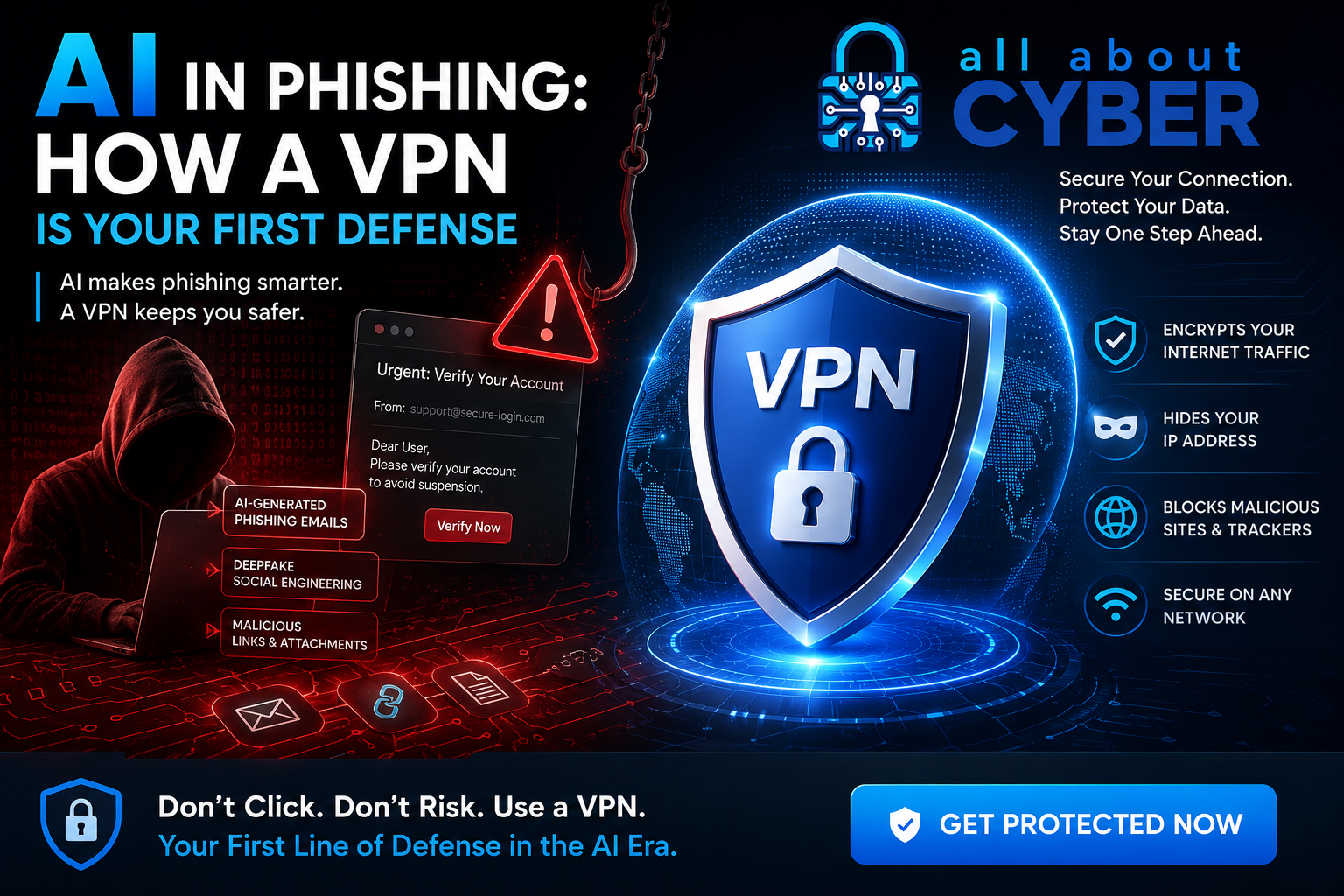
AI in Phishing: How a VPN is Your First Defense
Key Takeaways
- ✓ The New Threat Landscape: AI is the new engine for hyper-realistic, personalized phishing attacks that bypass traditional security measures.
- ✓ VPN as a Digital Shield: A VPN encrypts your internet traffic and masks your IP address, making it harder for attackers to target you.
- ✓ Human Factor: While a VPN is essential, the ultimate defense is a combination of technology and user vigilance.
- ✓ Proactive Security: A proactive security posture with a VPN at its core is the only way to stay ahead of AI-driven threats.
Introduction: The Unseen Evolution of a Classic Threat
Phishing. The term has been part of our digital vocabulary for decades. We've all seen the clumsy emails with poor grammar and suspicious links, promising Nigerian fortunes or warning of a locked bank account. For years, the golden rule was simple: if it looks suspicious, it probably is. But what if it doesn't look suspicious at all? What if it looks... perfect?
Welcome to the reality of cybersecurity in 2026. The game has changed, fundamentally and irrevocably. The catalyst for this change is Artificial Intelligence. Cybercriminals are now leveraging sophisticated AI models to craft phishing attacks of unprecedented realism and personalization. These aren't just emails anymore; they are multi-channel, context-aware social engineering campaigns that can fool even the most discerning eye. This article delves into the dark side of AI, explores how it's supercharging phishing attacks, and explains why a robust VPN is no longer a 'nice-to-have' but an absolute necessity in your digital defense arsenal.
AI is now the cybercriminal's most powerful tool for crafting believable scams.
How AI Creates the "Perfect" Phishing Attack
To understand the danger, we need to appreciate the tools. Modern AI, particularly Large Language Models (LLMs) and generative AI, can automate and perfect the elements of a phishing scam that were previously done poorly by humans.
-
➤
Flawless Language and Tone
Gone are the days of awkward phrasing. AI can generate emails, text messages, and social media posts in any language with perfect grammar, syntax, and even mimic specific writing styles. It can draft a formal email from your 'CEO' or a casual chat message from a 'colleague' with terrifying accuracy.
-
➤
Hyper-Personalization at Scale
AI algorithms can scrape the internet for public information about you or your company—from LinkedIn profiles, company websites, and social media. This data is then used to craft a message that seems uniquely tailored to you, referencing recent projects, colleagues' names, or personal interests, making the bait almost irresistible.
-
➤
Voice and Video Deepfakes
The threat now extends beyond text. AI can clone a voice from just a few seconds of audio. Imagine receiving a voicemail from your boss, in their actual voice, asking you to urgently transfer funds or provide sensitive information. This is no longer theoretical; it's happening now and is known as 'vishing' (voice phishing).
-
➤
Intelligent Automation
AI can run thousands of these campaigns simultaneously, probing for weaknesses and learning from its successes and failures. It can even automate the conversation in a chat-based scam, responding to your queries in real-time to build trust before delivering the malicious link.
The VPN: Your First Line of Defense
So, how do you fight back against an intelligent, automated adversary? You start by securing your connection to the internet. This is where a VPN becomes indispensable. A VPN creates a secure, encrypted tunnel for your internet traffic, acting as a powerful shield in several key ways:
1. IP Address Anonymization
Your IP address is like your digital home address. It reveals your general location and your Internet Service Provider (ISP). Phishers can use this to tailor attacks. A VPN masks your real IP address, replacing it with the IP of the VPN server. This makes it incredibly difficult for attackers to know who you are or where you're connecting from, disrupting their ability to personalize attacks.
2. End-to-End Encryption
When you connect to the internet, especially on public Wi-Fi (like at a café or airport), your data can be intercepted. A VPN encrypts all your data with military-grade AES-256 encryption. Even if a cybercriminal manages to intercept your traffic, all they'll see is unreadable gibberish. This is crucial if you accidentally click on a phishing link, as the VPN's encryption can protect the data you subsequently transmit.
3. Secure DNS
Many premium VPNs include their own private DNS servers. This prevents DNS hijacking, a technique where attackers redirect you from a legitimate website (like your bank) to a fake phishing site. With a secure DNS, your browser's requests are resolved safely within the encrypted tunnel.
4. Threat Blocking Features
Top-tier VPNs often come with built-in features that block malicious websites, ads, and trackers. If you click on a known phishing link, the VPN service can block the connection before the malicious site even has a chance to load, acting as a crucial safety net.
Conclusion: A Necessary Layer in Modern Security
AI-powered phishing is a formidable threat. It's smart, it's scalable, and it's incredibly deceptive. While no single tool is a silver bullet, a high-quality VPN is the closest thing we have to an essential, foundational layer of protection. It hardens your defenses by anonymizing your identity, encrypting your data, and providing a safe tunnel through the increasingly hostile digital world.
In 2026, going online without a VPN is like leaving your front door wide open. Don't wait to become a statistic in the new wave of AI-driven cybercrime. The time to act, and to encrypt, is now.
Alex Ivanov
Network Security Engineer
Alex is a network systems administrator and security researcher. He leads performance testing, latency profiling, and device compatibility checks.